


Valve Selection by Industry
Although valves perform essentially the same function, each industry brings different media, pressure, temperature and safety requirements. The right valve is selected from the answers to these questions: what the medium is, the temperature and pressure, the size, the type of connection, the required standard and where the valve will be installed.
Key Criteria for Correct Selection
Correct selection starts with determining the valve type suited to your line. The steps below present our ball valve types first, followed by the features to be specified for the type you select.

API 6D Double Block and Bleed (DBB) Ball Valve
What is it for?
API 6D Double Block and Bleed (DBB) Ball Valves are engineered to provide superior isolation, pressure control, and operational reliability.
Where is it used?
- Oil and Gas Pipelines
- Petrochemical Plants
- Power Generation
- Offshore Platforms
- Industrial Maintenance

What is an API 6D Pig Ball Valve Launcher and Receiver?
A Receiver: For safely retrieving the pig after its operation.
What is it for?
Designed to launch and receive pipeline pigs safely and effectively, these systems ensure that pipelines remain clean, operational, and free of blockages.
Where is it used?
- Oil and Gas Pipelines
- Petrochemicals
- Water Transmission
- Power Generation

What is an API 6D Fully Welded Ball Valve?
Our products are crafted with these features to meet the demands of our customers.
What is it for?
The API 6D Fully Welded Ball Valve is a critical component used for flow control in industrial pipelines. These valves stand out with their robust structure, superior performance and compliance with API 6D standards.
Where is it used?
- Oil and Gas Pipelines
- Petrochemical Industry
- Power Generation
- Water and Wastewater Management

What is the Burak Type Wafer Mono-block Ball Valve?
The Burak Type Wafer Mono-block Ball Valve is a specialized variation of the standard wafer mono-block ball valve. This valve features a single-piece body construction and is sandwiched between two flanges for easy installation and maintenance. The "Burak Type" signifies its specific design and high-performance capabilities, offering enhanced durability and versatility compared to traditional ball valves.
What is it for?
In the world of industrial fluid management, the Burak Type Wafer Mono-block Ball Valve has emerged as a top-tier solution for efficiently controlling the flow of liquids and gases.
Where is it used?
- Oil and Gas Industry
- Chemical Processing
- Water Treatment and Wastewater Systems
- HVAC Systems
- Pharmaceutical and Food Industries
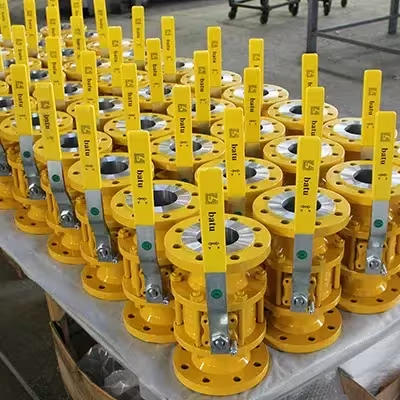
What is a Natural Gas Ball Valve?
Natural Gas Valve is a type of quarter-turn valve that uses a spherical ball with a hole through the center to control the flow of natural gas. The ball is housed within the valve body and rotates 90 degrees to either open or close the flow path. When the ball’s hole aligns with the flow path, the valve is open, allowing gas to flow freely. When the valve is closed, the ball rotates 90 degrees to block the flow, providing a tight seal.
What is it for?
In the natural gas industry, precise flow control is critical to ensuring safety, efficiency, and reliability. Natural Gas Ball Valves play a crucial role in maintaining optimal performance in gas transmission and distribution systems.
Where is it used?
- Natural Gas Distribution Systems
- Oil and Gas Pipelines
- Gas Metering Stations
- Power Plants
- Industrial Applications
- Emergency Shutdown Systems

What is an EU Ball Valve?
When the hole in the ball is aligned with the pipeline, the valve is open, allowing fluids to pass through. When the ball is rotated to the closed position, the hole is perpendicular to the flow path, preventing fluid from passing.
What is it for?
In industrial applications across Europe, efficient and reliable flow control is essential for optimal performance and safety. The EU Ball Valve is a critical component in fluid management systems, providing precise control over the flow of liquids, gases, and slurries in pipelines and process systems.
Where is it used?
- Oil and Gas Industry
- Chemical and Pharmaceutical Manufacturing
- Water and Wastewater Treatment
- HVAC Systems
- Food and Beverage Industry
- Energy Generation

What is a Steel Ball Valve?
Steel Ball Valve is a type of quarter-turn valve that uses a ball with a central hole to regulate the flow of fluid through a pipeline. The ball is rotated 90 degrees within the valve body to either open or close the flow path. When the hole in the ball is aligned with the flow path, the valve is open, allowing the fluid to pass. When the ball is rotated to the closed position, the hole is perpendicular to the flow path, effectively stopping the fluid. Made primarily from high-quality steel materials, these valves are designed to withstand harsh conditions, including high pressures, extreme temperatures, and exposure to corrosive substances. The steel valve’s durability, combined with its simplicity of design, makes it a reliable solution for fluid flow regulation across various industries.
What is it for?
When it comes to managing fluid flow in industrial applications, reliability and durability are paramount. The Steel Ball Valve is a critical component used to control the flow of liquids, gases, and slurries in pipelines, processing systems, and various other industrial operations.
Where is it used?
- Oil and Gas Industry
- Chemical Processing
- Water Treatment
- Power Generation
- HVAC Systems
- Food and Beverage Industry
- Pharmaceuticals

What is a High Pressure European Norm Ball Valve?
High Pressure European Norm (EN) Ball Valve is a type of valve that uses a spherical ball with a hole through its center to regulate the flow of fluids (liquids, gases, or slurries) under high-pressure conditions. The ball valve operates with a 90-degree rotation of the ball to either open or close the flow path. When the hole in the ball is aligned with the flow path, the valve is open, allowing fluid to pass through. When the ball is rotated to the closed position, the hole is perpendicular to the flow path, effectively blocking the flow.
What is it for?
When working with high-pressure systems, ensuring the safe and efficient flow of liquids, gases, or slurries is critical. The High Pressure European Norm (EN) Ball Valve is specifically engineered to meet the rigorous demands of such environments.
Where is it used?
- Power Generation
- Chemical Processing
- Water Treatment and Desalination
- Cryogenic Applications
- HVAC Systems
- Marine and Offshore Operations

What is a Cast Iron Water Ball Valve?
A Cast Iron Water Valve is a type of ball valve specifically designed for controlling the flow of water in pipelines. The valve works by using a spherical ball with a hole through the center, which rotates 90 degrees to open or close the flow path. When the hole in the ball is aligned with the pipe, the valve is open, allowing water to flow through. When the ball is rotated 90 degrees, the hole is perpendicular to the flow path, effectively closing the valve and stopping the water flow.
What is it for?
When it comes to managing water flow in industrial, municipal, or residential systems, the importance of reliable and durable valves cannot be overstated. Among the most trusted solutions for such applications is the Cast Iron Water Ball Valve.
Where is it used?
- Municipal Water Systems
- Water Treatment Plants
- Irrigation Systems
- Residential Plumbing
- Fire Suppression Systems
- Industrial Water Systems

What is a 3 Way Ball Valve?
A 3-Way Ball Valve is a type of ball valve that has three ports and a spherical ball with a hole through its center. The ball in a 3-Way Valve has a specially designed passage that can connect two or more flow paths, allowing fluid to be redirected, mixed, or split.
What is it for?
In industries that deal with complex fluid systems, controlling the direction of flow with precision is often a challenging task. The 3 Way Ball Valve is an innovative solution designed to handle the demanding requirements of flow redirection, mixing, and diverting.

What is a Jacket Ball Valve?
A Jacket Valve is a type of ball valve that is designed with an additional jacket or outer layer around the valve body. This jacket surrounds the valve and allows the circulation of heating or cooling fluids, such as steam or hot water, through it. This thermal control mechanism helps maintain the desired temperature of the fluids passing through the valve, preventing issues like freezing, solidification, or overheating, which could otherwise cause clogging or damage to the system.
What is it for?
In many industrial applications, controlling the temperature of the fluids passing through pipelines is crucial for ensuring the efficiency and safety of the system. This is where the Jacket Ball Valve comes into play.
Where is it used?
- Chemical Processing
- Oil and Gas
- Food and Beverage
- Pharmaceuticals
- Water Treatment
- HVAC Systems
- Cryogenic Applications
Industry Applications
The same valve family is applied with different selections depending on the industry. The preferred choice for each application is summarised below; see the application page for details.
Fire-safe, antistatic and low-emission valves are to be preferred; on underground lines the maintenance-free fully welded body is the leading choice.
A high pressure class, material suited to low temperature and NACE-compliant material for sour gas are required; on platforms, compact valves take priority.
On lines with no space for a pigging station, the pig launcher and receiver ball valve, which combines the valve, launcher and bypass in a single body, is preferred.
Fire-safe and antistatic design is required; the Burak type mono-block ball valve developed for this field is the leading choice.

Fire-safe, low-emission valves complying with API 6D and ASME are to be used.
Body and seal materials suited to the medium are to be selected; for viscous or solidifying media the jacket ball valve is preferred.
Material suited to the temperature is to be selected and a strainer fitted at the line inlet; steel and high pressure ball valves are used on steam lines.

Cast iron and sphero or steel ball valves are preferred in water and air installations; a strainer is used at the line inlet and a check valve against backflow.