

Conversion Table For Ansi Norm To Din Norm
CONTENTS
Our Products
Conversion Table For Ansi Norm To Din Norm (Class 150 – 2500)
DIN valves are rated by a nominal pressure in bar (PN) and ANSI/ASME valves by a dimensionless Class, so the two ratings have to be matched before a valve replaces another on the same line. The ANSI Class to DIN PN conversion below gives the equivalents together with the psi, bar and MPa values behind them.
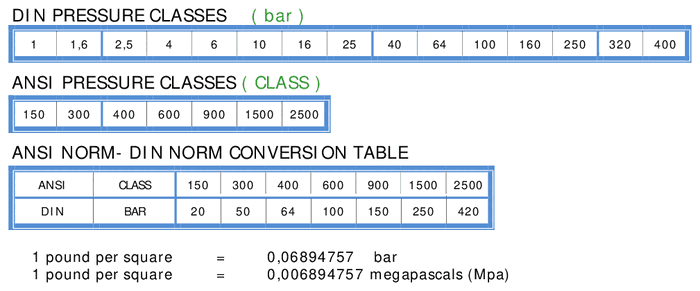
Pressure classes are expressed differently in the two dominant valve standards: DIN states a nominal pressure in bar (PN), while ANSI/ASME uses a dimensionless pressure Class. The tables below give the classes used on Batu Vana ball valves and the accepted conversion between them.
DIN pressure classes (PN, bar)
| PN (bar) | 1 | 1.6 | 2.5 | 4 | 6 | 10 | 16 | 25 | 40 | 64 | 100 | 160 | 250 | 320 | 400 |
|---|
ANSI pressure classes (Class)
| Class | 150 | 300 | 400 | 600 | 900 | 1500 | 2500 |
|---|
ANSI norm – DIN norm conversion
| ANSI (Class) | 150 | 300 | 400 | 600 | 900 | 1500 | 2500 |
|---|---|---|---|---|---|---|---|
| DIN (bar) | 20 | 50 | 64 | 100 | 150 | 250 | 420 |
Pressure unit conversions
- 1 pound per square inch (psi) = 0.06894757 bar
- 1 pound per square inch (psi) = 0.006894757 megapascal (MPa)
What a Class Is and What a PN Is
The two systems answer the same question in different languages. PN is a nominal pressure in bar at a reference temperature, defined in EN 1092. Class is dimensionless and comes from the pressure-temperature tables of ASME B16.5, where the permitted pressure depends on the body material group as well as the temperature.
That difference is why an ANSI Class to DIN PN conversion can only ever be approximate. One side is a number in bar; the other is a family of curves. The table above pairs them at the point where they are closest, which is ambient temperature.
The Pairings and Their Limits
The customary equivalents are PN 20 with Class 150, PN 50 with Class 300, PN 110 with Class 600, PN 150 with Class 900, PN 260 with Class 1500 and PN 420 with Class 2500. Read across the ANSI Class to DIN PN conversion and the ratings line up closely enough for a first pass.
They separate as soon as temperature enters. EN and ASME derate on different curves and group materials differently, so two bodies that match at 20 °C can differ by a useful margin at 250 °C. Where the duty is hot, do not stop at the ANSI Class to DIN PN conversion: take both ratings from their own pressure-temperature tables at the working temperature and compare those.
Ratings Match, Flanges Do Not
This is the part that stops a job on site. An ANSI Class to DIN PN conversion tells you the two valves are rated for the same pressure; it says nothing about whether they bolt together, and usually they do not.
A DN 100 PN 16 flange carries eight M16 bolts on a 180 mm circle. The nearest ANSI equivalent, NPS 4 Class 150, also carries eight bolts, but on a 190.5 mm circle and in 5/8 inch. Same bolt count, different circle: the holes never line up. The ANSI Class to DIN PN conversion is a rating tool, not a dimensional one.
Face-to-Face Is a Second Trap
Valve lengths follow EN 558 on the DIN side and ASME B16.10 on the ANSI side, and the two rarely agree. A valve chosen through the ANSI Class to DIN PN conversion can therefore be correct on pressure and still leave a gap or fail to fit the space between the existing flanges.
Check the face-to-face dimension against the standard the line was built to before ordering. Where a substitution is unavoidable, a short spool piece is cheaper than a valve that has to be returned.
Facing, Gaskets and Bolting
Raised face heights differ as well: ASME Class 150 and 300 use a 1.6 mm raised face, while EN form B1 is 2 mm. Bolting is metric on one side and inch on the other, and the gasket has to match the facing it sits on. None of this appears in an ANSI Class to DIN PN conversion, and all of it has to be settled before a joint is made up.
The practical rule on site is simple: order the valve to the flange standard the line was built to, and use the ANSI Class to DIN PN conversion only to confirm that the pressure rating is adequate.
Wafer and Lug Bodies Sit Between Two Standards
Butterfly and check valves are usually clamped between the line flanges rather than bolted to them, which makes the flange standard even more decisive. A wafer body is machined to centre itself on a particular bolt pattern, so a body built for PN 16 will sit off-centre in a Class 150 line and the disc can foul the pipe bore when it opens.
Lug bodies are worse, because the tapped holes have to align exactly with the bolts of the mating flanges. Here the ANSI Class to DIN PN conversion is genuinely misleading if it is read alone: the pressure rating may be perfectly adequate while the body cannot be installed at all. State the flange standard on the order, not just the rating taken from the ANSI Class to DIN PN conversion.
Read the Marking, Not the Catalogue
Bodies are marked with their class or PN, the material designation and the size. When an existing valve is being replaced, take the rating from that marking rather than from a drawing that may predate the last modification, then run the ANSI Class to DIN PN conversion from what is actually installed.
Related Tables
The dimensional half of the question is next door. The DIN flange dimensions table and the ASME B16.5 flange dimensions give the bolt circles and hole patterns that decide whether two flanges can meet, and the psi to kg/cm² conversion covers the unit side. Used together with the ANSI Class to DIN PN conversion above, they answer both halves of a substitution: is it strong enough, and does it fit.
Reference: ASME Codes and Standards — the source of the ANSI/ASME pressure classes

